Hours after an immigration agent fatally shot Renee Good inside her S.U.V. on a Minneapolis street last month, a senior federal prosecutor in Minnesota sought a warrant to search the vehicle for evidence in what he expected would be a standard civil rights investigation into the agent’s use of force.
The prosecutor, Joseph H. Thompson, wrote in an email to colleagues that the Minnesota Bureau of Criminal Apprehension, a state agency that specializes in investigating police shootings, would team up with the F.B.I. to determine whether the shooting had been justified and lawful or had violated Ms. Good’s civil rights.
But later that week, as F.B.I. agents equipped with a signed warrant prepared to document blood spatter and bullet holes in Ms. Good’s S.U.V., they received orders to stop, according to several people with knowledge of the events who spoke on the condition of anonymity because they were not authorized to speak publicly.
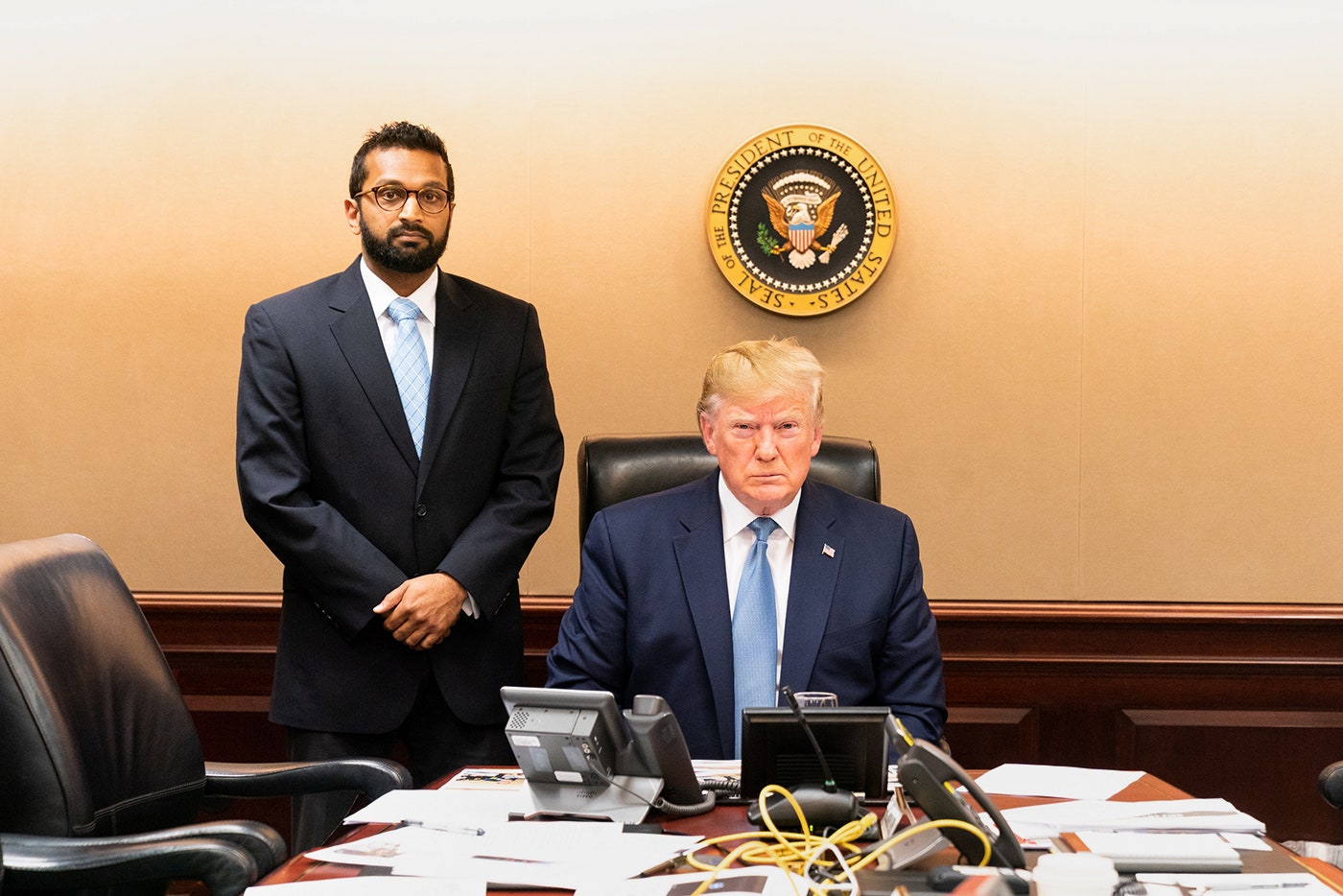
The orders, they said, came from senior officials, including Kash Patel, the F.B.I. director, several of whom worried that pursuing a civil rights investigation — by using a warrant obtained on that basis — would contradict President Trump’s claim that Ms. Good “violently, willfully, and viciously ran over the ICE Officer” who fired at her as she drove her vehicle.
Over the next few days, top Department of Justice officials presented alternative approaches. First, they suggested prosecutors ask a judge to sign a new search warrant for the vehicle, predicated on a criminal investigation into whether the U.S. Immigration and Customs Enforcement agent who shot Ms. Good, Jonathan Ross, had been assaulted by her. Later, they urged the prosecutors to instead investigate Ms. Good’s partner, who had been with Ms. Good on the morning of the shooting, confronting immigration agents in their Minneapolis neighborhood.
Several of the career federal prosecutors in Minnesota, including Mr. Thompson, balked at the new approach, which they viewed as legally dubious and incendiary in a state where anger over a federal immigration crackdown was already boiling over. Mr. Thompson and five others left the office in protest, setting off a broader wave of resignations that has left Minnesota’s U.S. attorney’s office severely understaffed and in crisis. Officials have not said whether they ultimately obtained a new warrant to search the vehicle.
It’s easy to become desensitized when every week Trump does something far worse than anything Nixon got forced out of office for, but ending a murder investigation because it would embarrass the president is an unspeakable abuse of power.
Yesterday, in response to the despicable killing of Renee Good by a masked ICE agent, Minneapolis mayor Jacob Frey used an even more justified profanity. His statement is angry, it is powerful, and it is worth watching.1 I’ll quote part of it here:
They are already trying to spin this as an action of self-defense. Having seen the video myself, I want to tell everybody directly, that is bullshit. This was an agent recklessly using power that resulted in somebody dying, getting killed.
…
I do have a message for our community, for our city, and I have a message for ICE. To ICE: Get the fuck out of Minneapolis.
We do not want you here. Your stated reason for being in this city is to create some kind of safety, and you are doing exactly the opposite. People are being hurt. Families are being ripped apart. Long-term Minneapolis residents that have contributed so greatly to our city, to our culture, to our economy are being terrorized, and now, somebody is dead. That’s on you.
Let’s go one further. ICE should get the fuck out of existence.
Abortion will remain legal in Wyoming after the state Supreme Court ruled Tuesday that two laws barring the procedure, including the country’s first explicit ban on abortion pills, violate the state constitution.
The justices sided with the state’s only abortion clinic and others who had sued over the abortion bans passed since 2022, when the U.S. Supreme Court overturned the landmark Roe v. Wade decision.
Wyoming is one of the most conservative states, but the 4-1 ruling from justices all appointed by Republican governors was unsurprising in that it upheld every previous lower court ruling that the abortion bans violated the state constitution.
Wellspring Health Access in Casper, the abortion access advocacy group Chelsea’s Fund and four women, including two obstetricians, argued that the laws violated a state constitutional amendment ensuring competent adults have the right to make their own health care decisions.
Voters approved the constitutional amendment in 2012 in response to the federal Affordable Care Act. The justices recognized that the amendment wasn’t written to apply to abortion but said it’s not their job to “add words” to the state constitution.
Never let it be said that Sarah Palin didn’t accomplish something useful once!
Trump has responded to the murder of a civilian by an ICE agent in Minneapolis by defending an entirely fictious scenario with no resemblance to the facts that are easily observable on video:
This is the ICE agent President Trump says was "violently, willfully, and viciously ran over … hard to believe he is alive."
Mayor Frey, to his credit, preemptively pushed back forcibly at the inevitable claims from the government that a woman was shot from the side of her car out of “self-defense”:
Minneapolis Mayor Jacob Frey forcefully pushed back against any suggestion that the fatal shooting involving a federal immigration agent was an act of self-defense.
“This was an agent recklessly using power that resulted in somebody dying, getting killed,” Frey said.
Frey said claims that the shooting was justified are false and misleading.
“What I can tell you is the narrative that this was just done in self-defense is a garbage narrative that is not true,” he said. “It has no truth, and it needs to be stated very clearly.”
The administration’s lies about what happened beed to be countered as forcefully as possible as often as possible.
And no matter how bad you think the facts are, they’re worse:
"A doctor at the scene attempted to help the woman who was shot, but was kept away by federal agents. When an ambulance finally arrived, it was blocked from reaching her by law-enforcement vehicles, and paramedics had to reach her on foot. The woman has died." www.theatlantic.com/ideas/2026/0…
In anticipation of the Purple Line’s scheduled opening in 2027, Montgomery County officials are looking at places to build sidewalks near the light rail line. But plans to build sidewalks near the future Takoma-Langley station, on University Boulevard in Takoma Park, have been shelved in part because neighbors say they’re afraid of “stranger danger.”
Staff at the Montgomery County Department of Transportation (MCDOT) identified eight residential streets within a half-mile of the station that were missing sidewalks, then sent information about the proposal to over 150 nearby households. Fewer than half replied, but those who did were mostly against it. According to the letter from Robert Gonzales, Sidewalk Section Chief, of the 73 residents who responded, just 12 supported the sidewalks.
“In the remaining 61 comments, residents heavily opposed the installations,” Gonzales wrote, “expressing concerns about loss of available parking, lack of need, financial loss due to tree and landscaping removals, loss of environmental beauty and the ‘natural feel’ of the community, stranger danger, increased crime, littering, and, most of all, the worsening of stormwater flooding and erosion.”
Gonzales added that the county’s budget doesn’t have enough money to install the sidewalks anyway. “Our decision is clear,” he concluded. “None of the proposed sidewalks will be installed.”
“Stranger danger” is a concept dating to the 1960s, when high-profile cases of children being abducted or murdered began appearing in the news. If you grew up in the 1990s like me, you probably remember pictures of missing kids on milk cartons or round-the-clock news coverage about child kidnappings.
In a now-deleted Bluesky post, an agency staffer said they asked residents in Bethesda’s Kenwood neighborhood, where thousands of people go to see cherry blossoms each spring, about building sidewalks. MCDOT decided not to after 50 households–a majority of those who replied, but just 20% of the whole neighborhood–were opposed.
Screenshot of a deleted post from MCDOT’s Bluesky page.
Even in neighborhoods where there’s vocal support for pedestrian improvements, MCDOT is slow to act. The agency rejected a Rockville neighborhood’s request for a stop sign near Wood Middle School after a driver hit one child, and only relented after another child was killed by a school bus. Here in East Silver Spring, my neighbors and I are pushing for stop signs at two intersections where drivers hit me and my dog and an 11-year-old boy this year. Bethesda Today recently covered that effort and was told by Michael Paylor, who’s in charge of traffic engineering and operations at MCDOT, that “sometimes it’s the best interest of the county to do nothing.”
Montgomery County boasts that it’s one of the first places in the United States to adopt Vision Zero, pledging to end all traffic fatalities by 2030. But between January and October 2025, 358 pedestrians were involved in a crash, 12 of whom died. That’s basically the same as four years ago. Giving people more safe places to walk by building more sidewalks, especially near a transit station that many people will walk to, would go a long way in reversing this trend. If this county were serious about safety, it wouldn’t use “stranger danger” as a reason not to build sidewalks.
The Department of Transportation is overseen by County Executive Marc Elrich, who is term-limited and is instead running for County Council. Next year’s Democratic primary on June 23, 2026 will likely decide his successor, who will be responsible for the agency. We’ll be endorsing in the executive and county council races, and asking the candidates if they support building more sidewalks–or making more excuses.
I’ve been meaning to write about this interesting essay by Michael Green, about how the poverty line could be pegged at $140,000 per year, if we’re talking about what he calls “the cost of participation” in contemporary American life.
Some of the claims in the essay are hyperbolic, and it was largely derided by the green eyeshade battalions of the dismal science, but it nevertheless struck a nerve for good reasons. For example:
Critics will immediately argue that I’m cherry-picking expensive cities. They will say $136,500 is a number for San Francisco or Manhattan, not “Real America.”
So let’s look at “Real America.”
The model above allocates $23,267 per year for housing. That breaks down to $1,938 per month. This is the number that serious economists use to tell you that you’re doing fine.
In my last piece, Are You An American?, I analyzed a modest “starter home” which turned out to be in Caldwell, New Jersey—the kind of place a Teamster could afford in 1955. I went to Zillow to see what it costs to live in that same town if you don’t have a down payment and are forced to rent.
There are exactly seven 2-bedroom+ units available in the entire town. The cheapest one rents for $2,715 per month.
That’s a $777 monthly gap between the model and reality. That’s $9,300 a year in post-tax money. To cover that gap, you need to earn an additional $12,000 to $13,000 in gross salary.
So when I say the real poverty line is $140,000, I’m being conservative. I’m using optimistic, national-average housing assumptions. If we plug in the actual cost of living in the zip codes where the jobs are—where rent is $2,700, not $1,900—the threshold pushes past $160,000.
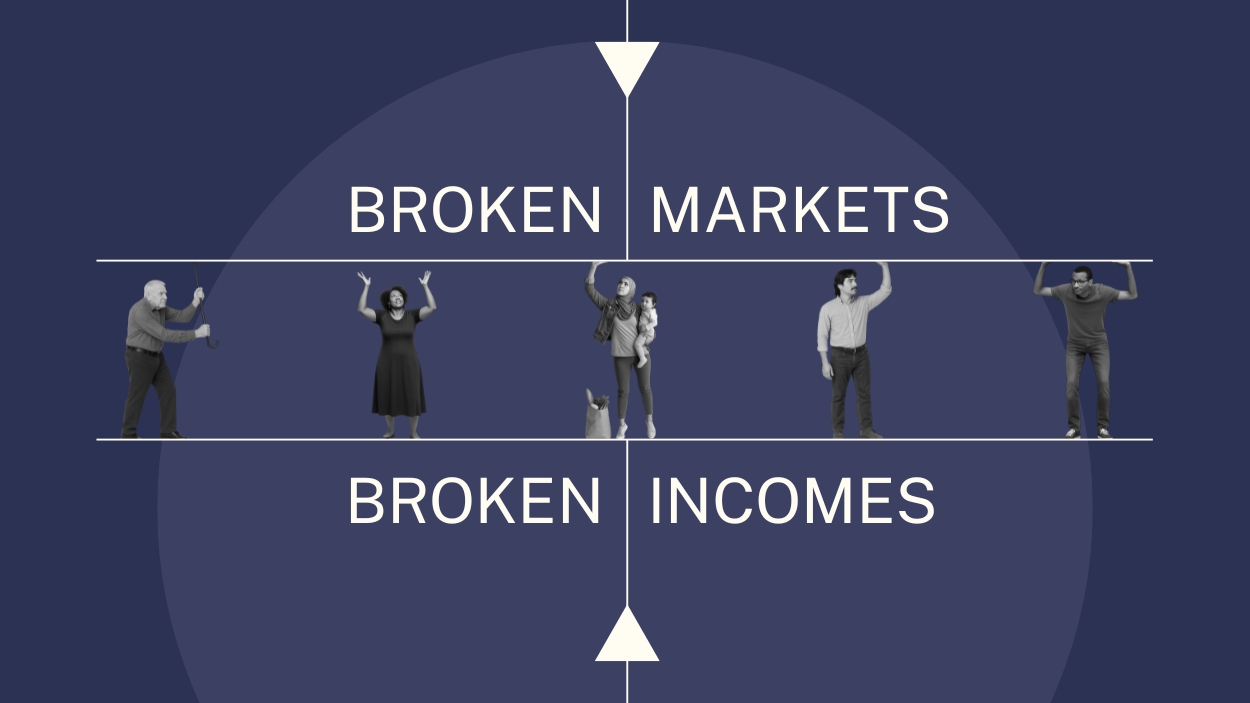
The market isn’t just expensive; it’s broken. Seven units available in a town of thousands? That isn’t a market. That’s a shortage masquerading as an auction.
And that $2,715 rent check buys you zero equity. In the 1950s, the monthly housing cost was a forced savings account that built generational wealth. Today, it’s a subscription fee for a roof. You are paying a premium to stand still.
Green emphasizes that for couples with young children, childcare costs are a devastating addition to household budget. For many people in their 20s and 30s, this means “choosing” to be childless, because it feels fundamentally unaffordable. This of course helps explain why the birth rate has been cratering for decades — it’s now quite literally half of what it was when I was born at the peak of the baby boom. And the birth rate in the US is still a lot higher than in much of the developed world, The worst situation, not surprisingly, is in countries that still have strongly patriarchal traditional cultures, i.e., women are expected to do all childcare and other domestic labor, but where women also now have a certain degree of economic and social freedom. In places like South Korea, the consequence of that combination is a total fertility rate of less than one — a completely unprecedented situation in all of recorded history, and no doubt in the entire history of the species, or otherwise we wouldn’t be here to blog about it.
The Times had a piece today (gift link) that used Green’s essay as a jumping off point. The basic economic problems here are well known: the cost of housing, of childcare, of health care, and of higher education. These things are all central to any concept of a middle class lifestyle. Of course another big factor in all this are changing standards of what’s considered an acceptable version of such a lifestyle:
Mr. Thurston, from Philadelphia, said he wanted children. But right now, he and his partner must climb three floors to their rental apartment. Their car is a two-door “death trap.”
His salary, about $90,000, would need to cover student loans and child care. He also wants to live in a good school district and pay for extras, like music lessons and sports leagues.
“I know you don’t need those things,” he said, “but as a parent, my job is to set my child up for success.”
Even for those who own a home, the thought of children can be daunting. Stephen Vincent, 30, and his partner, Brittany Robenault, a lab technician, first went to community college to save money. Then, he said, they “ate beans and rice” for several years to save for a down payment.
Now an analyst for a chemical company with a household income of about $150,000, he likes his lifestyle in Hamburg, Pa., and wants to keep it.
“We live in the richest country in the history of human civilization, so why can’t I eat out twice a week and have kids?” he said.
To the skeptics who say these trade-offs are simply lifestyle choices, there was a rejoinder: Hey, you try it.
“It’s very easy from a place of wealth and privilege to say, ‘You should be happy with something more modest,’” Mr. Thurston said.
But, he said, “it would kind of suck to live that way.”
Alicia Wrigley is grappling with the trade-offs. Ms. Wrigley and her husband, Richard Gailey, both musicians and teachers, own a two-bedroom bungalow in Salt Lake City and feel lucky to have it — they say they could not afford it now. But juggling in-home music lessons with their 2-year-old’s needs can feel like a squeeze. They want another child, but wonder how it would all work.
“I know it’s possible,” she said, looking through the window at her next-door neighbor’s house, which is exactly the same size.
That neighbor raised six children there in the 1970s. One way mothers then would cope, Ms. Wrigley said, was to “turn their kids out all day, and they’d just run around the neighborhood.”
She said she would not do that today, not least because someone might report her.
“The world,” she said, “is fundamentally different now.”
This is reminds me obliquely of a passage in The Road to Wigan Pier, Orwell’s study of life in a mining town in northern England in the mid-1930s. Orwell is interviewing a family of eight living in a four-room house (I would guess this would probably be in the neighborhood of 800 square feet or so), and he asks them when they became aware of the housing crisis. “When we were told of it,” is the reply.
. . . commenter Felix D’s question about this passage led me to look it up, and it’s somewhat different than I recalled, but the gist is the same:
Talking once with a miner I asked him when the housing shortage first
became acute in his district; he answered, 'When we were told about it',
meaning that till recently people's standards were so low that they took
almost any degree of overcrowding for granted. He added that when he was
a child his family had slept eleven in a room and thought nothing of it,
and that later, when he was grown-up, he and his wife had lived in one
of the old-style back to back houses in which you not only had to walk a
couple of hundred yards to the lavatory but often had to wait in a queue
when you got there, the lavatory being shared by thirty-six people. And
when his wife was sick with the illness that killed her, she still had
to make that two hundred yards' journey to the lavatory. This, he said,
was the kind of thing people would put up with 'till they were told
about it'.
 Log in









 reply
reply